We Scanned 5 Popular AI Repos and Found Zero Governance Controls
Last month we scanned five popular open-source AI repositories. Combined, they have over 470,000 GitHub stars. These are projects that thousands of companies depend on.
We found 389 AI SDK detections, 116 compliance findings, and not a single governance framework fully mapped in any of them.
One of them had a BIS Entity-Listed Chinese AI provider buried in the codebase. The company almost certainly didn’t know it was there.
Today we’re open-sourcing the scanner that found all of this.
What the Scanner Found
The repos ranged from AI gateway platforms to workflow automation to personal AI assistants. Here’s the summary:
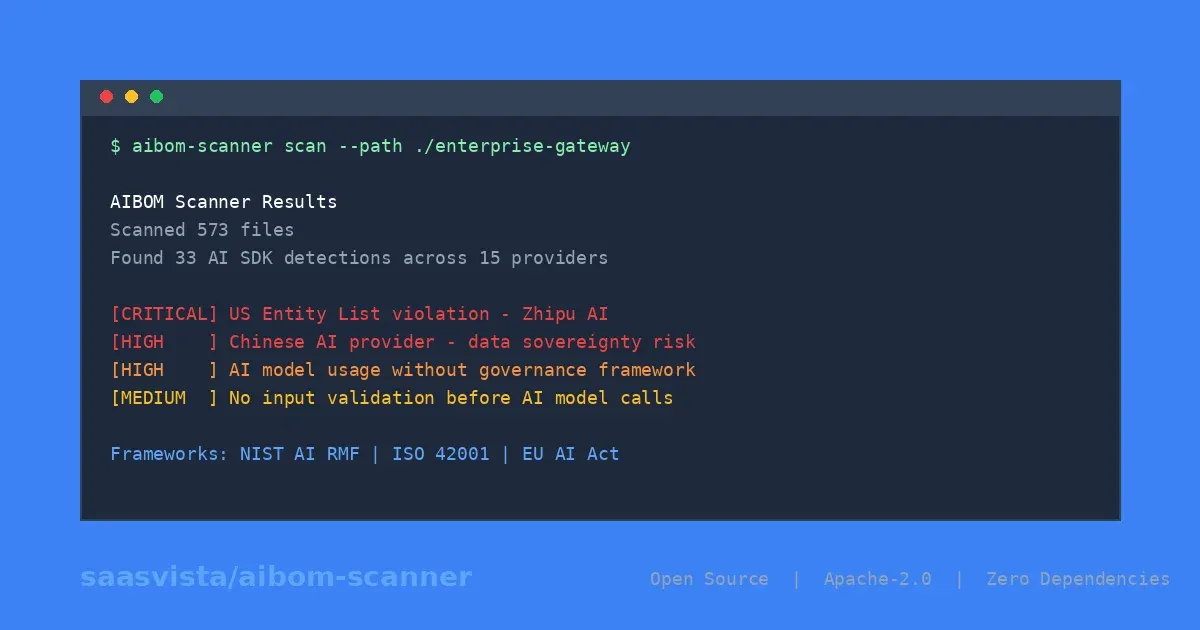
Portkey (AI gateway, 33 detections): 15 AI providers in one codebase. Zhipu AI — a provider on the US BIS Entity List — was integrated alongside OpenAI, Anthropic, and Cohere. That’s not a configuration choice. That’s an export compliance violation.
n8n (workflow automation, 375 detections): LangChain accounted for 350 of the 375 detections. DeepSeek (Chinese-hosted, data sovereignty risk) was present. No secrets management beyond environment variables.
khoj (personal AI assistant, 43 detections): Eight AI providers including OpenAI, Anthropic, Google AI, AWS Bedrock, HuggingFace, and MCP. Solid architecture, but zero compliance framework mapping.
The pattern is the same across every repo we scanned: AI SDKs get added to solve an engineering problem, and nobody maps them to compliance frameworks. Nobody builds an inventory. Nobody checks whether the provider is on a sanctions list.
You can’t govern what you can’t see.
Why We Open-Sourced It
The scanner behind these findings has been the core of our Trust Pack product. It detects 61 AI SDK patterns across 30+ providers, classifies risks against 34 rules, and maps findings to 48 compliance controls across NIST AI RMF, ISO 42001, and the EU AI Act.
We decided to open-source it because this problem is too big for one company to solve with consulting engagements. Every team shipping AI needs to know what’s in their codebase. Making them wait for a sales call to find out doesn’t help anyone.
The tool is called aibom-scanner — as in AI Bill of Materials. My friend Bryan Patton (Principal at Quest Software) coined the term AIBOM a few weeks ago, and it stuck. If SBOMs became mandatory after Log4J, AIBOMs are the obvious next step.
What It Detects
The scanner runs against a local directory. No API keys needed, no data sent anywhere. Zero dependencies beyond Python’s standard library.
AI Providers (30+): OpenAI, Anthropic, Google AI, AWS Bedrock, Azure OpenAI, Cohere, Mistral, Groq, HuggingFace, Together AI, Fireworks, Replicate.
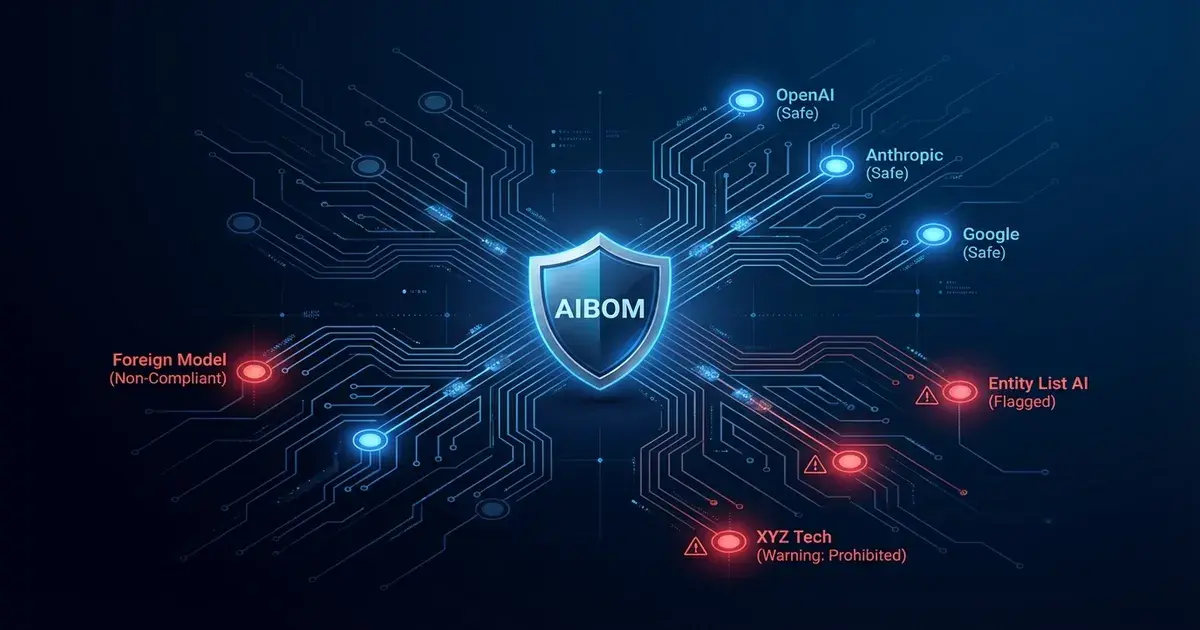
Chinese AI (10 providers, 3 BIS Entity-Listed): Zhipu AI, iFlytek, and SenseTime are on the US BIS Entity List. All three trigger CRITICAL findings. DeepSeek, Alibaba Qwen, Baidu ERNIE, Moonshot, MiniMax, Baichuan, and Yi trigger HIGH data sovereignty findings.
Agentic AI: CrewAI, AutoGen, LangGraph, Semantic Kernel, and MCP (Model Context Protocol). These get flagged because autonomous agents without human-in-the-loop controls are a governance gap that every enterprise questionnaire now asks about.
Secrets management: Detects whether you’re using Vault, AWS Secrets Manager, or just environment variables. Finds hardcoded API keys. Adjusts severity based on what it finds — if you have a real secrets manager, the key exposure risk drops to LOW.
Framework mapping: Every finding maps to specific controls in NIST AI RMF (23 controls), ISO 42001 (15 controls), and the EU AI Act (10 articles). You get a gap analysis showing which controls are mapped, which are partial, and which are completely missing.
How to Use It
pip install aibom-scanner

aibom-scanner scan --path /your/repo
That’s it. Table output in the terminal, JSON when piped, SARIF for GitHub Code Scanning.
Want to fail CI when critical findings exist?
aibom-scanner scan --path . --severity-threshold highThere’s a GitHub Action too:
- uses: saasvista/aibom-scanner@v1
  with:
    severity-threshold: high
What the Scanner Doesn’t Do (And What We Charge For)
The open-source scanner finds the problems. It tells you what AI is in your codebase, what the risks are, and which compliance controls are missing.
What it doesn’t do is generate the remediation evidence. The enriched findings with business impact analysis, the 30/60/90-day action plan, the Response Kit that answers 27 enterprise due diligence questions with evidence from your actual code — that’s the Trust Pack, and that’s what we sell.
Think of it like this: the scanner is the X-ray. The Trust Pack is the treatment plan.
If you’re a startup selling into enterprise and a buyer just sent you an AI governance questionnaire, the scanner will show you the gaps. The Trust Pack will help you close them.
The Uncomfortable Finding
The repo that alarmed us most was Portkey. It’s an AI gateway — a tool that other companies use to route their AI traffic. And it has Zhipu AI integrated.
Zhipu AI (智谱AI) was added to the US BIS Entity List in January 2025, along with 10 subsidiaries. iFlytek has been on the list since 2019. SenseTime since 2019. Any US company transacting with these providers faces export license requirements with a presumption of denial.
The uncomfortable part: most teams don’t know these providers are in their code. They get pulled in through dependency chains. LangChain supports dozens of providers. LiteLLM routes to over 100. If your orchestration layer supports a provider, and someone enables it, you now have a compliance problem you never chose.
That’s why scanning matters. Not because you’re doing something wrong — because you might not know what your code is doing.
What’s Next
EU AI Act enforcement starts August 2026. Enterprise procurement questionnaires are already asking for AI governance documentation. The companies that can answer with evidence — not promises — win the deals.
The scanner is Apache-2.0 licensed. It’s on GitHub at saasvista/aibom-scanner.
Scan your repos. See what you find. If the results concern you, we can help.
Mike Carroll
Founder & Field CTO at SaaSVista
30+ years in IT security and infrastructure. Previously CISSP certified, 2004-2022. Helping B2B SaaS startups prove AI governance readiness to enterprise buyers.